2026 Best LED Down Lights for Global Buyers?
Choosing the best Led Down Light in 2026 requires more than comparing wattage and price. Global buyers must examine optical performance, thermal design, certification, installation depth, and long-term reliability. A bright sample in a showroom can still create glare across a kitchen island or uneven pools on a hotel corridor.
Lighting researcher Peter R. Boyce wrote, “The purpose of lighting is to make things visible.” His principle remains useful for modern LED selection. A dependable Led Down Light should provide the right brightness, beam angle, color temperature, and color rendering for its location. CRI 90 may suit galleries and retail displays. CRI 80 can be practical for offices and circulation areas. Warm 2700K light feels comfortable in bedrooms, while 4000K often supports clearer workplace visibility.
This guide compares leading 2026 options for contractors, distributors, architects, and property owners. It considers lumen output, UGR control, dimming compatibility, heat dissipation, driver quality, and service life. Regional requirements also matter. A product accepted in one market may need different documentation elsewhere. Buyers should verify test reports, warranty terms, ingress protection, and installation instructions before ordering.
No shortlist is perfect. Product specifications can change, and laboratory results may not match a dusty ceiling or unstable voltage. I may still overlook a strong regional model. That is why practical checks matter: inspect the driver, read the photometric file, and test one fitting before purchasing thousands. The best choice is not always the brightest or cheapest. It is the Led Down Light that performs consistently in the real space.
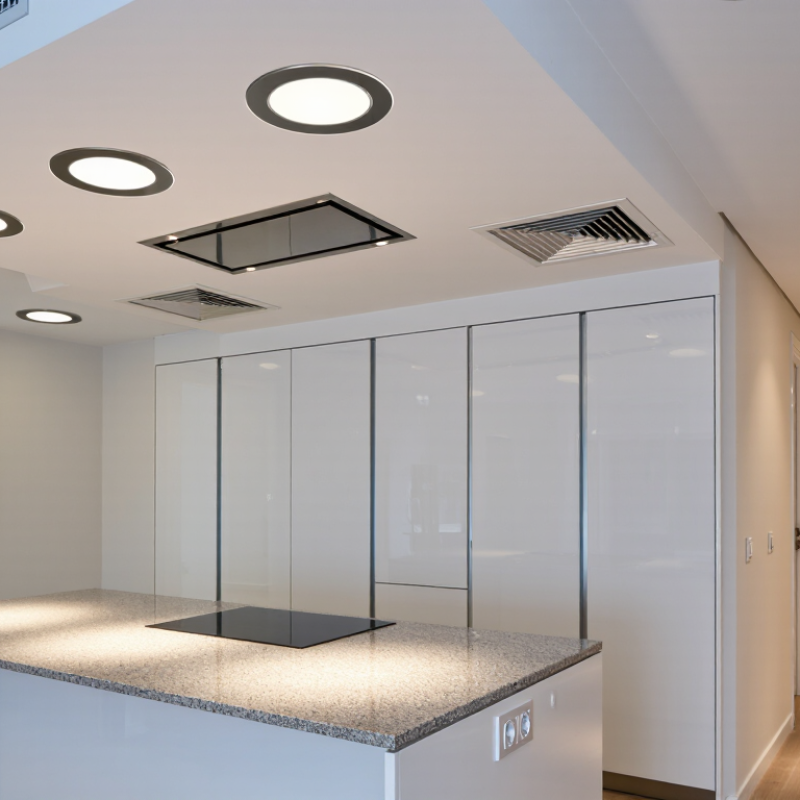
What LED Downlights Are and How They Work
2026 Best LED Down Lights for Global Buyers?
What LED Downlights Are and How They Work
An LED downlight is a compact ceiling fixture that directs light through a narrow opening. Its LED chip converts electrical energy into visible light more efficiently than older filament sources. A driver changes incoming AC power into controlled DC power for the chip. That small component strongly affects flicker, lifespan, dimming, and reliability.
The chip produces heat as well as light. A metal heat sink moves heat away from the LED and into the surrounding air. Heat is the enemy. Poor ventilation can reduce brightness and shorten service life, even when the advertised wattage looks attractive. A reflector or lens shapes the beam, while the color temperature influences the room’s appearance. Warm white often suits bedrooms, while neutral white can support kitchens and work areas.
In practical installations, I check the ceiling cutout, driver position, insulation contact, and dimmer compatibility before comparing prices. A higher lumen number alone can mislead. Beam angle matters more in some spaces, especially over counters or display surfaces. Wet locations require an appropriate IP rating, and buyers should verify local electrical and fire-safety requirements. Certified testing is useful evidence, but installation quality still matters. I have seen carefully specified fixtures perform poorly because connectors were loose or airflow was blocked. That is an uncomfortable detail, yet it deserves attention.
LED downlights are recessed luminaires that use light-emitting diodes to convert electrical energy into light. Their driver regulates the incoming power and supplies the LED chips with the required current. This chart shows the electricity consumed by common LED downlight power ratings when operated for 1,000 hours. Energy use is calculated as: watts × operating hours ÷ 1,000.
Comparing LED Downlight Types for Different Global Applications
2026 Best LED Down Lights for Global Buyers?
Comparing LED Downlight Types for Different Global Applications
Choosing an LED downlight depends on the room, ceiling structure, climate, and local electrical requirements. Fixed recessed models suit offices, corridors, and living rooms with consistent ceiling heights. Their narrow installation profile creates a clean appearance, but beam angles must match the room layout. A 36-degree beam can highlight artwork, while a 60-degree beam spreads light across work areas. Fit matters.
Adjustable downlights work well in retail spaces, galleries, and hospitality interiors. Their tilting mechanism directs light toward displays without moving the fixture. However, frequent adjustment may reveal weaker joints in low-quality products. Project teams should inspect the housing, spring clips, driver access, and heat management before ordering large quantities. Small tests prevent expensive replacements.
Damp or wet locations require suitable ingress protection, especially in bathrooms, coastal properties, and humid climates. Surface-mounted downlights help when concrete ceilings cannot accept recessed housings. Tunable white versions can support cooler task lighting and warmer evening scenes, but they add control-system complexity. Always check voltage compatibility, dimming performance, color consistency, and certification requirements for the destination market. Local rules differ. No selection is perfect. In my experience, buyers sometimes overvalue wattage and overlook glare, maintenance access, and ceiling insulation. A modestly powered fixture can perform better when optics and spacing are properly designed. Recheck the plan before committing.
How to Evaluate Efficiency, Lifespan, Safety, and Smart Features
For global buyers, LED downlights should be judged by delivered light, not chip claims. The U.S. Department of Energy’s solid-state lighting reports show laboratory LED efficacy above 200 lumens per watt, while complete fixtures perform lower. Ask for fixture efficacy, beam angle, color consistency, and power-factor data.
A 900-lumen downlight using 10 watts delivers 90 lumens per watt.
A test bench matters more.
Lifespan requires careful reading. L70 indicates when light output falls to 70 percent, but it does not guarantee failure-free operation. Request LM-80 data, TM-21 projections, and the test-case temperature. Heat trapped above a ceiling can shorten service life sharply. In practical installations, poor ventilation often matters more than the advertised 50,000 hours. I would not accept that number without temperature evidence.
Safety documents should reference IEC 60598-1 for luminaires, IEC 61347 for controlgear, and IEC 62471 for photobiological safety. Check surge protection, insulation, emergency behavior, and flicker performance.
Smart features deserve equal skepticism. Confirm wireless standards, offline operation, software-update policies, and data handling. The International Energy Agency continues to identify efficient lighting as a major electricity-saving opportunity, but connected controls can waste energy when poorly configured. A reliable downlight should dim smoothly, restore settings after outages, and remain usable when the network fails. That last detail is easy to miss.
Global Buying Factors: Certifications, Installation, Warranty, and Cost
2026 Best LED Down Lights for Global Buyers?
For global buyers, certification should match the installation country, not merely appear on a product sheet. Check applicable IEC, EN, UL, or other local requirements with an independent testing body. Verify the certificate number, product model, rated voltage, and test scope. A document for one housing size may not cover another. This detail is easy to miss.
Installation conditions affect performance more than many buyers expect. Confirm ceiling thickness, cut-out diameter, driver location, insulation contact, and dimmer compatibility before ordering. In humid rooms, suitable ingress protection matters. In older buildings, unstable voltage may require a wider input range. Ask for wiring diagrams and installation photographs. They reveal practical problems quickly. A downlight can fit perfectly and still create glare, heat, or maintenance trouble.
Warranty terms deserve careful comparison. Check coverage length, labor responsibility, replacement procedures, and exclusions for installation errors. Keep test reports, invoices, and batch records. They support future claims. Cost should include shipping, customs, spare drivers, energy use, and replacement labor. The cheapest unit may become expensive after repeated failures. A higher initial price is not automatically better, either. Review lumen output, color consistency, thermal design, and expected lifetime from measurable data. One useful question remains: can the supplier explain every figure without vague promises?